A First Shared Zine, Planned Around One Clear Question
Plan a first shared zine around one clear question, with practical ways to welcome different forms, resolve snags and make contributions feel at home.
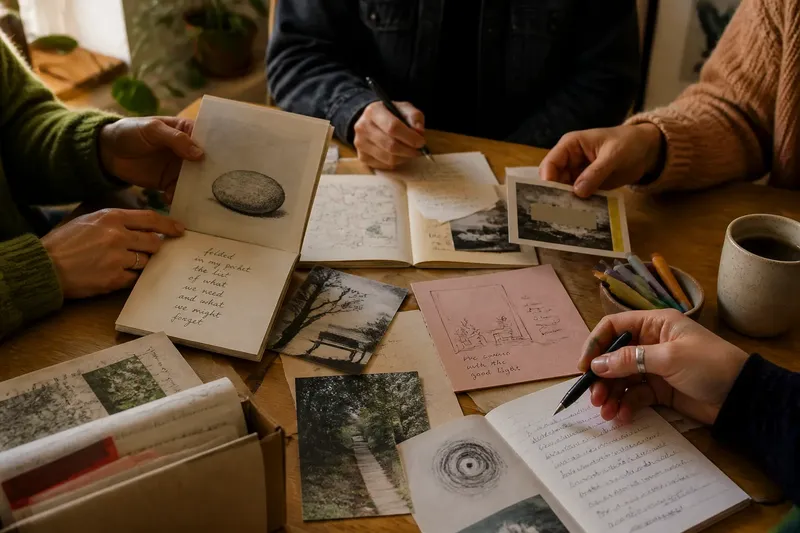
“What do we keep in our pockets?” is a question a group can answer with a drawing, a short memory, a list, or a photograph. That is the useful promise of a first shared zine: one clear question gives contributors a common starting point without asking them to sound alike.
The trouble often begins when the question is too broad, the invitation feels like an assignment, or someone tries to make every page match. Treat the question as a doorway rather than a rule. The plan below follows common snags in order, from choosing the prompt to deciding what belongs in the finished zine.
Choose a question with room for several kinds of answers
A prompt such as “What is community?” may feel weighty and open-ended, leaving people unsure where to begin. At the other extreme, “Draw a blue mug” has a clear answer but little room for distinct experiences. Look for a question that is concrete enough to spark a memory or observation, yet open enough to invite different responses.
Try saying possible questions aloud and noticing what they invite. “What do we carry home?” might lead to a bus ticket, a recipe, a voice note, or a story about an object. “Where do you go when you need a pause?” might bring in a map, a few lines of text, a collage, or a description of a quiet corner. A good prompt offers many doors, not one expected answer.
Keep the wording brief, and decide whether it needs a boundary. If the group is making a zine for a particular gathering or neighbourhood, a small frame such as “on the way here” can make the prompt feel easier to approach. Avoid adding so many qualifiers that the question becomes a hidden test of who has the right experience.
Make the invitation feel like an opening, not a brief
A polished call for contributions can accidentally sound like a list of requirements. Contributors may wonder whether they need specialist materials, a finished idea, or permission to write in their own language. Say plainly that rough, short and varied contributions are welcome, and explain what will happen to the work after it is submitted.
Offer several possible forms without turning them into categories people must choose from: a few sentences, a small drawing, a found phrase with context, a recipe, a hand-drawn route, or a question of their own. Mention that a person can contribute more than once or work with someone else if that suits them. If the zine has practical limits, such as a small page count or a print-only format, state them simply so nobody has to guess.
Also make room for people who do not want to contribute. A shared creative project should not treat participation as a loyalty test. Someone might help fold copies, read a draft, or simply receive one; those choices do not need to be framed as lesser versions of joining in.
When contributions arrive in different forms, let the question connect them
A common snag is the belief that every contribution must use the same medium or tone. That often leads to forced uniformity: a poem is shortened to fit a caption, a drawing is given an explanatory paragraph, or a funny page is made solemn to match the rest. The guiding question can provide the connection instead. The pages do not need to imitate one another if they are all responding to the same invitation.
Think of the question as a tablecloth: it gives a shared surface, but it does not make every object on the table identical. A page of handwriting can sit beside a photocopied map or a block of colour, provided the sequence helps readers sense why each contribution is there. Add a short note only when readers genuinely need context, and ask the contributor how they want that context handled.
Say you are making a zine around “What do we keep in our pockets?” One person offers a charcoal drawing of a smooth stone, another writes a few lines about a folded shopping list, and a third submits a photograph of a transit card with the identifying details obscured. The expected observable result is a set of pages that answer the same question through different forms, rather than three versions of one prescribed format.
When the prompt feels too personal, offer a way to step back
Questions about home, memory, identity or belonging can bring up more than a contributor intended to share. If somebody hesitates, do not press for a more revealing version. They can answer through an invented speaker, focus on an object or place, respond with a question, or pass altogether.
Set a simple boundary for sensitive material before collecting pages. Contributors should know whether the zine will be shared beyond the group and whether their name will appear. If a page includes another person’s private words or image, ask the contributor to remove identifying details or seek that person’s agreement before it is used.
The group may also need a way to say, “This part is not for print.” Treat that as a normal editorial choice, not a failure of openness. A contribution can matter to the making of the zine even if the contributor later chooses not to include it.
When some voices take up more space, change the invitation
A shared question does not automatically create equal room. Confident writers may send several pages while quieter members are still deciding what they want to say. Rather than asking everyone to contribute in the same way, offer a private route for ideas: a conversation with a trusted member, a dictated note, or a page made together with a partner.
Pay attention to whose work is easy to read in the chosen format. A handwritten page may be hard to reproduce, a long text may dominate the layout, or a photograph may reveal more than its maker intended. Ask contributors what adaptations are acceptable, and preserve their choices where possible. Editing for legibility should not quietly change the meaning or voice of a contribution.
For a small group, a gentle check-in can be more useful than a formal round in which everyone must speak. Ask whether the prompt still feels workable and whether anyone needs another way to respond. Keep the question open to revision if the group discovers that its wording is narrowing the work instead of helping it grow.
When the pages do not seem to belong together, inspect the sequence
Mixed forms can feel scattered if the pages are simply placed in the order they arrived. Before rewriting contributions, try arranging them by a light connection: objects before places, private notes before shared scenes, or short pieces between longer ones. The aim is not to manufacture a single argument. It is to give readers a path through different answers.
Use a plain paper mock-up before committing to a layout. Write a few words on scrap paper to represent each page, then move them around and read the sequence aloud. A repeated image, word or contrast may become visible only when the pieces sit next to each other. If nothing links two pages, that does not mean either must be removed; a blank page, a simple divider or a change of pace can give the reader room to shift.
Watch for edits that make the collection smoother but less truthful. Correcting a spelling choice, trimming a pause or adding a title can affect a contributor’s voice. Ask before making changes beyond agreed copy-editing, and let people see the page that will carry their work if the layout alters its presentation.
When the group cannot tell what represents it, keep the claim modest
A zine assembled by a group can be mistaken for a statement on behalf of everyone in it. That is especially likely when the cover uses a collective “we” or the title sounds like a shared declaration. Be precise about what the zine is: a collection of responses to one question from the people who chose to contribute, not a complete account of a group or place.
Credit can follow the same principle of clarity. Ask each contributor how they want to be named, including whether they prefer a pseudonym or no name. Acknowledge practical roles such as editing, drawing, assembling or organising where those people want that work recognised. Do not assume that one person’s role gives them ownership of every page.
If the group has different views about a page, name the actual concern rather than smoothing it over as a matter of taste. Is the worry about privacy, readability, the prompt, or the impression the page gives about the whole group? A specific concern gives contributors something they can respond to without asking them to surrender their voice.
How can you keep the first zine manageable?
What makes a guiding question too broad?
If people repeatedly ask what kind of answer is expected, the wording may be abstract or carry too much weight. Add a concrete anchor, such as an object, place or moment, while keeping several forms of response possible.
Can one zine include writing, pictures and found material?
Yes, if each item responds to the shared question and its maker agrees to its use. Give found material enough context to avoid presenting another person’s words or image as the contributor’s own.
What if someone changes their mind about a contribution?
Agree in advance how and when contributors can withdraw or revise a page before the zine is shared. If a change is no longer practical after printing or distribution, be honest about that limit and discuss the available options without blaming the person.
How do we know the zine is ready to share?
Check that contributors have seen how their work appears, that the intended audience is clear, and that the cover does not claim to speak for people who did not take part. Then decide together whether the collection feels complete enough to circulate, rather than waiting for every page to express the same idea.
Let the first zine stay small enough to finish
A first shared zine does not need to settle every difference in a group or carry a grand message. It can be a modest collection shaped by one clear question, a thoughtful invitation and care for how each contribution appears. That is enough structure to help people make something together without asking them to become one voice.
Before sharing copies, return to the prompt and read it beside the pages. If readers can see how the contributions answer it, even when the answers disagree or use different forms, the question has done its job. For a first shared zine, that kind of connection is more useful than a polished sameness.