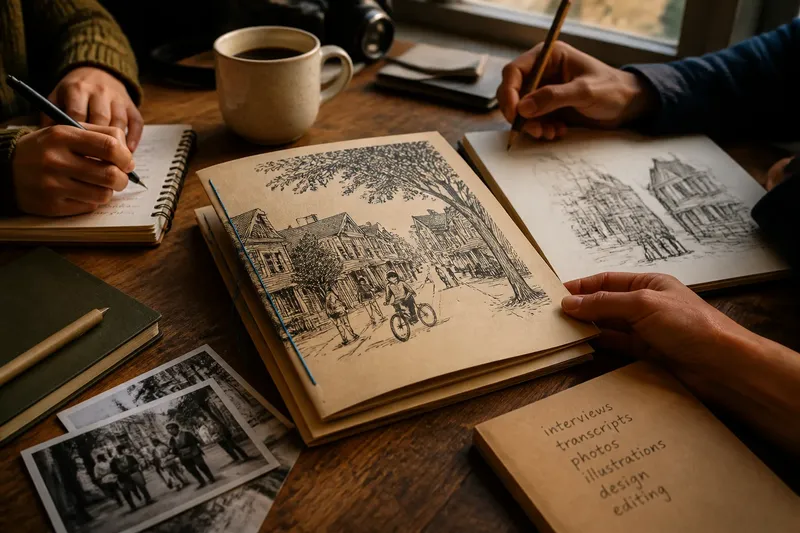
The Shared Idea Board Needs a Place for Unfinished Thoughts
A shared idea board with a clear space for unfinished thoughts lets a group explore freely while keeping suggestions distinct from agreed decisions.
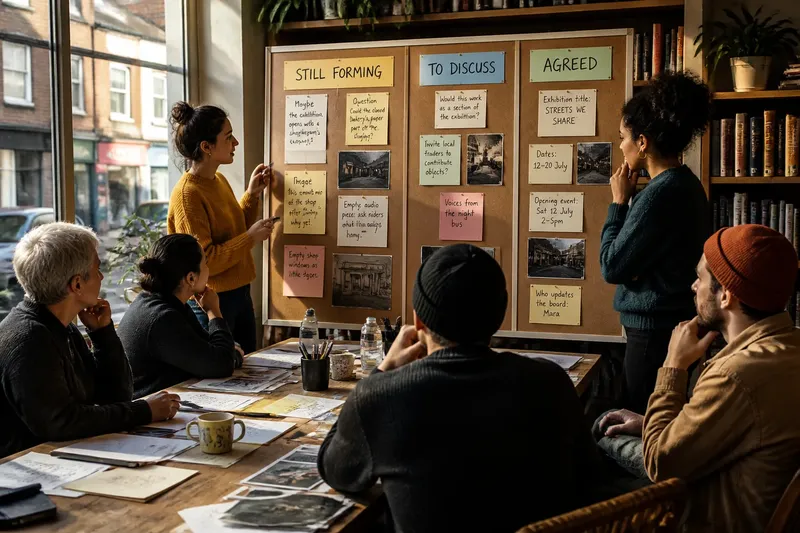
“Does this mean we’ve decided to make the whole project about migration?” asks Mara, looking at a note someone added to the shared idea board. The note was only a fragment, but it has already been copied into the group’s working outline. A shared idea board needs a place for unfinished thoughts so the group can explore possibilities without accidentally treating every suggestion as a commitment.
That distinction sounds small until people start making plans around a phrase that nobody remembers approving. In collective creative work, a board is not just a surface for collecting ideas; it also signals how much weight each idea carries. Give early fragments a separate home, and participants can be more candid while the group keeps its decisions legible.
Unfinished thoughts need a different status from decisions
Imagine a neighbourhood arts group preparing a small exhibition about how people experience a local high street. Six members meet in a library room, then continue adding thoughts to a shared board between sessions. At first, the board has one open column called “Ideas”. It fills with possible titles, memories, materials, themes and practical questions.
One member writes “empty shop windows as little stages”. Another adds “voices from the night bus”. Someone else suggests inviting local traders to contribute objects. Each note may be useful, but none has yet been discussed in enough detail to become a plan. The shared column gives every thought the same visual status, so the group starts confusing presence with approval.
This is a design problem, not a failure of anyone’s attention. A sentence on a board can look settled simply because it is neat, visible and written in the same style as the rest. Separating fragments from decisions tells readers what they are looking at before they begin interpreting the content.
Think of the board like a kitchen table with a tray for scraps and a plate for food that is ready to serve. Both belong to the meal, but they invite different kinds of handling. A scrap can be tasted, changed or set aside; a finished plate is something the group intends to put in front of others.
The group gives exploratory notes their own landing place
After the mix-up, the group changes the board rather than asking people to become more careful. It creates three plain-language areas: “Still forming”, “To discuss” and “Agreed”. The first holds fragments that may need another sentence or a conversation. The second holds proposals the group wants to consider together. The third is reserved for choices that have actually been made.
The members agree that anyone can add a note to “Still forming”, without asking permission or presenting a polished case. If a thought seems ready for discussion, its author or another member can move it into “To discuss” and add a question such as, “Would this work as a section of the exhibition?” Moving a note is an invitation to consider it, not a claim that the group supports it.
They also give each note a little context. Rather than writing “night bus”, a member adds, “Possible audio piece: ask riders what they notice on the journey home.” That sentence remains provisional, but it helps the group understand what kind of idea is being proposed. A fragment does not have to become a pitch deck; it only needs enough shape to be read fairly.
For notes that are genuinely half-formed, the board allows questions, images, single words and rough sketches. A member who is unsure whether an image belongs to the exhibition can post it with “This reminds me of the shop after closing; not sure why yet.” The uncertainty is useful information. It prevents a reader from mistaking an association for a request to make a specific artwork.
A short description protects a fragment from being overread
The group adds a simple convention: a note in “Still forming” can begin with a cue such as “Maybe”, “Question” or “Image”. These are not grades, and nobody has to use a prescribed vocabulary every time. They are small signals that help someone scanning the board distinguish a possible direction from a settled instruction.
For instance, “Maybe the exhibition opens with a shopkeeper’s account” is visibly different from “Opening section: shopkeeper’s account”. The first suggests a possibility to examine; the second sounds like work has been assigned and the order fixed. Wording can quietly turn a tentative thought into an apparent obligation, so the group pays attention to verbs as well as labels.
They avoid turning every note into a miniature proposal form. If people must supply a rationale, audience analysis and production plan before they can share an intuition, the board will favour ideas that are already easy to explain. A light cue and one clarifying sentence are enough for a fragment to travel without pretending to be finished.
Say Noor adds, “Could the closed bakery’s paper bags become part of the display?” She places it under “Still forming” and adds, “I’m thinking about what a street leaves behind, not asking anyone to collect bags.” The expected observable result is that the group can discuss the image without treating it as an instruction to gather materials or as a decision to use them.
How should the board handle a promising fragment?
Can anyone add an unfinished thought?
Usually, yes: a shared exploratory area is most useful when members do not need permission to contribute a rough note. The group can set boundaries around what belongs on the board, such as keeping private details out, while leaving room for ideas that are uncertain or incomplete.
When does a fragment move into discussion?
Move it when someone is ready to ask the group to consider a particular possibility, not merely because it has attracted attention. Add a clear question or proposal so members know what response is being invited.
What if a note stays unfinished?
It can remain there, be combined with another fragment, or be set aside when the group tidies the board. An unresolved note is not a debt its author owes the group; its value may be in helping someone else find a different connection.
How can the group show that a decision is settled?
Use a distinct “Agreed” area and record the actual choice in plain language, along with any useful conditions. The group should also name who will update the board after a decision, so an old proposal does not keep circulating as if it were current.
The group moves proposals through discussion without rushing them
At the next meeting, the members look at the notes in “To discuss” and choose which ones deserve time. They take the empty shop windows first. The group asks what the image might allow them to explore, what access or permissions may be needed, and whether it connects to the exhibition’s question about everyday life on the high street.
The conversation changes the idea. Rather than using actual shop windows, the members consider making a series of framed street observations in the library. They decide that this direction is worth developing, but leave the materials and contributors open. The board records that limited decision: “Develop framed observations of the high street; decide format and contributors later.” It does not promote the original phrase wholesale into the agreed area.
This middle stage matters. A proposal can gain support in one part and remain unsettled in another. Recording the scope of the decision lets members build on what they have chosen without quietly filling in details that are still up for discussion.
The members also notice that “voices from the night bus” attracts interest, but raises questions about privacy and whether participants would want their words displayed. They leave it under “To discuss” with those questions attached. That is not rejection, and it is not approval: it is an honest account of where the group has got to.
A board needs a gentle way to revisit old fragments
As the board grows, the group adds a light-touch review at the start of a working session. Members scan old fragments and ask whether each one still feels useful, whether it belongs beside another note, or whether it can be archived. They do not vote on every stray thought. Tidying is about keeping the space readable, not forcing closure on every idea.
When a note is set aside, the group keeps it in an archive rather than deleting it without a trace. A brief reason can help: “Not for this exhibition; keep for later work” or “Joined to the framed observations idea.” This gives members a way to see that an idea was noticed even if the current project cannot use it.
The group is careful not to make the archive a hidden second decision space. The active board remains the place to find current proposals and agreements; the archive is a record of older material, not a queue of promises. If someone brings back an archived thought, the group can discuss it afresh rather than assume it has been waiting for approval.
They also keep the layout visually plain. A clear label, a short sentence and a date or meeting reference when useful are easier to read than a maze of colours that only one person understands. If the group uses a tool such as Miro, a shared document or sticky notes on a wall, the same principle applies: status should be visible without requiring a private explanation.
The exhibition takes shape without turning every note into a promise
As planning continues, the group develops the framed observations and leaves the night-bus idea unresolved. Noor’s bakery-bag fragment prompts another member to propose a drawing of traces left by daily shopping, which the group discusses on its own merits. The original note has done useful work without being mistaken for a materials order.
By the time the group prepares a description for visitors, its board contains a small set of explicit decisions and a separate collection of live questions. Members can tell which parts of the exhibition are settled, which are being developed and which are simply ideas they may return to. Nobody has to remember that a phrase on the first board was “only a thought”.
The practical lesson is to design the board around the different jobs ideas do. Let fragments be visible without making them sound like instructions, give proposals a place to receive discussion, and write agreements narrowly enough that they do not decide more than the group intended. A shared idea board works best when it makes room for uncertainty and makes commitment unmistakable.
When you set up a shared idea board, start by choosing labels that your own group would use in conversation. Then ask, whenever a note moves, what changed: did it become clearer, become a proposal, or become an agreed choice? That small question keeps the board useful to the people making the work, not just tidy to look at.